
Young children in Bloomington grow up in a community where they regularly encounter different people, cultures, words, and ways of communicating. From preschool classrooms and neighborhood parks to family outings around the Twin Cities, these everyday experiences make the early years a natural time to introduce children to more than one form of language.
Multilingual learning in early childhood can give children meaningful opportunities to listen, communicate, notice patterns, and understand that an idea can be expressed in different ways. Spanish immersion provides repeated exposure to a spoken language, while sign language adds a visual and physical dimension to communication. Research on bilingual development suggests potential benefits in areas such as language awareness and some aspects of cognitive development, although researchers continue to study how consistently specific cognitive advantages appear across children and settings.
What Bloomington Families Should Know
-
Young children are capable of learning and distinguishing more than one language without needing to master one language before encountering another.
-
Spanish immersion works best as meaningful, repeated exposure through conversations, songs, stories, routines, and play rather than isolated vocabulary drills.
-
Sign language gives children another way to connect words and concepts with visible movements and gestures.
-
Families in Bloomington can reinforce language learning during ordinary activities, including walks at Normandale Lake Park, trips to the library, and conversations during everyday routines.
-
Consistency and interaction matter more than expecting a young child to memorize long vocabulary lists.
Why Is Early Childhood a Valuable Time for Multilingual Learning?
Early childhood is a valuable time for multilingual learning because young children are actively building the listening, communication, memory, and social skills they use to understand their surroundings. Regular exposure to Spanish and sign language can make different forms of communication a familiar part of daily life rather than a separate academic subject.
Preschool-age children learn extensively through repetition and context. A Spanish word used during snack time, a sign paired with a familiar song, or a phrase repeated during cleanup can become meaningful because the child connects language with an action or experience.
That approach fits naturally into life in Bloomington. A child might learn words for trees, water, birds, colors, or weather while exploring local green spaces such as Hyland Lake Park Reserve or Nine Mile Creek Park. Language becomes connected to something the child can see, hear, touch, or do.
For families exploring early learning with Kinderplatz, multilingual education can be viewed as part of a broader approach to communication and discovery. We encourage families to consider how language can become part of meaningful childhood experiences rather than simply another set of facts to memorize.
How Can Spanish Immersion Support Young Learners?
Spanish immersion can support young learners by surrounding them with meaningful opportunities to hear and use Spanish during familiar activities. Instead of relying only on translated vocabulary lists, immersion connects language with stories, play, songs, questions, objects, movement, and everyday routines.
Children might hear greetings as they arrive, words for colors during art, numbers during a game, or simple phrases while playing with classmates. Repetition gives those words context.
Research involving bilingual and Spanish-English-speaking children has explored connections between bilingual experience and executive functions such as attention, working memory, and cognitive flexibility. Findings are not uniform. Some studies have identified advantages in particular tasks or groups, while broader research has found that the overall executive-function advantage associated with bilingualism can be small or inconsistent.
For parents, the more dependable takeaway is simpler: learning another language gives a child practice communicating across different linguistic systems and recognizing that the same person, object, or idea can have more than one label.
How Does Sign Language Benefit Communication in Early Childhood?
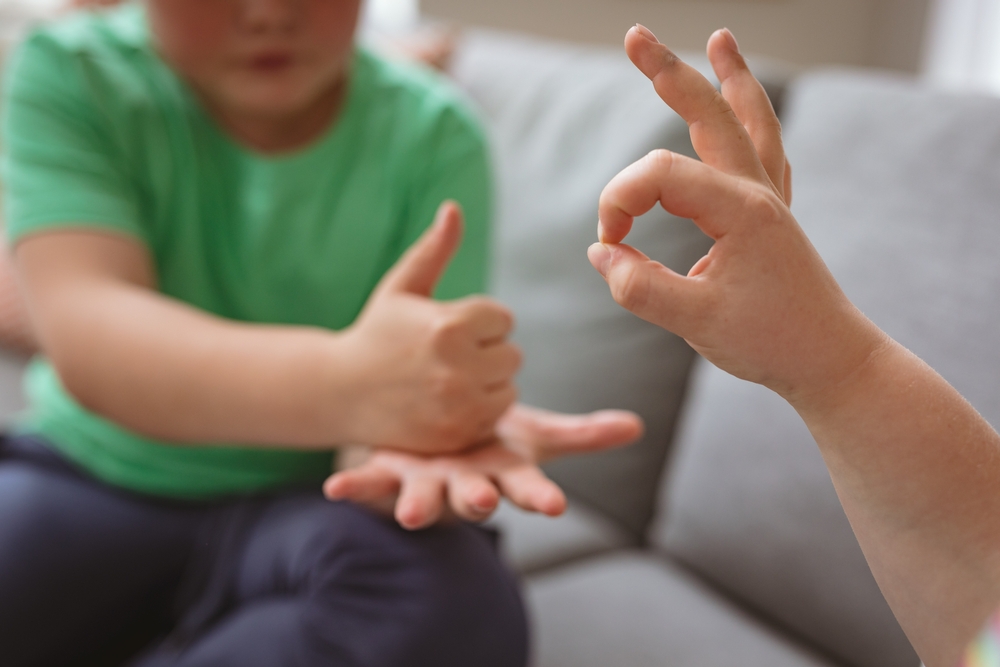
Sign language can benefit early communication by pairing language with visible hand movements, facial expressions, and physical actions. This gives children another way to connect a concept with meaning and can make language activities especially interactive.
Sign languages are complete natural languages, not simply collections of gestures. Research involving Deaf and hard-of-hearing children also demonstrates the developmental importance of early access to an accessible language.
In an early childhood environment, age-appropriate signs can be incorporated into songs, stories, greetings, transitions, and other routines. Children can see a sign, connect it with a concept, and participate physically.
For young learners who naturally enjoy moving, copying, pointing, and interacting, that visual component can make communication engaging.
What Does Research Say About Multilingual Learning and Young Brains?
Research shows that multilingual experience can shape how children process and use language, while claims of a universal cognitive advantage should be treated carefully. Studies have reported relationships between bilingual experience and specific executive-function skills, but results vary depending on age, language proficiency, exposure, socioeconomic factors, and the tasks researchers use.
For example, research published through sources indexed by the National Institutes of Health has examined Spanish-English bilingual children and skills involving attention, working memory, inhibition, and switching between tasks. Some studies have found advantages for bilingual groups in particular areas. Other research and meta-analysis have found limited or inconsistent differences.
That distinction matters for Bloomington parents. Spanish exposure does not need to make a child universally “smarter” to be valuable. Learning to understand and communicate in another language is itself a meaningful developmental and practical skill.
What Can Multilingual Learning Look Like During a Preschool Day?
Multilingual learning during a preschool day can be woven into routines children already understand, allowing new language to develop through repetition and context. Effective exposure does not have to feel like a formal language lesson.
A morning greeting can introduce a familiar Spanish phrase. Counting objects can reinforce numbers. A song can pair spoken words with movement. Teachers can use signs during recurring activities, and stories can expose children to familiar concepts expressed in another language.
This type of learning can also extend beyond the classroom. Bloomington families might practice colors while walking around Bush Lake, count objects during a visit to a local park, or name familiar foods during a family meal.
The goal is not constant testing. It is creating opportunities for children to hear, observe, respond, experiment, and communicate.
What Signs Show That a Child Is Engaging With a New Language?
Signs of engagement with a new language often appear gradually through recognition, imitation, gestures, and understanding before fluent speech develops. Parents should look for growing participation rather than expecting immediate conversation in Spanish or perfect reproduction of signs.
Common signs can include:
-
Recognizing frequently repeated Spanish words or phrases
-
Responding appropriately even without repeating the word
-
Copying a familiar sign during a song or routine
-
Using a new word spontaneously during play
-
Switching between familiar words for the same object
-
Showing interest when hearing Spanish outside the classroom
-
Teaching a parent or sibling a word or sign learned during the day
Language development varies considerably among young children, so individual progress should not be judged solely by how many new words a child says.
How Can Bloomington Parents Reinforce Multilingual Learning at Home?
Bloomington parents can reinforce multilingual learning by using short, enjoyable language activities consistently instead of turning home practice into formal lessons. Songs, picture books, counting games, greetings, and repeated signs can give children additional opportunities to connect language with everyday life.
Parents do not have to be fluent in Spanish to show enthusiasm for language learning. Asking a child to share a word from the day can give the child an opportunity to become the teacher.
Local outings offer additional possibilities. Families can talk about animals and plants near the Minnesota River Valley, practice nature vocabulary around Hyland-Bush-Anderson Lakes Park Reserve, or count objects during a neighborhood walk.
The best reinforcement feels like interaction, not homework.
What Common Mistakes Should Families Avoid?
Common multilingual-learning mistakes include expecting immediate fluency, correcting every attempt, and treating language as memorization instead of communication. A better approach gives children time to listen, experiment, make mistakes, and encounter familiar language repeatedly.
One mistake is assuming that a child who understands a Spanish word but answers in English has learned nothing. Understanding often develops differently from spoken production.
Another is turning every interaction into a quiz. Constantly asking “What does this mean?” can make language feel like a test. Using words naturally in songs, games, stories, and routines provides context instead.
Families should also avoid comparing one child’s language development too closely with another’s. Children differ in temperament, exposure, interests, and developmental pace.
What Is a Common Multilingual Learning Scenario in Bloomington?
A common multilingual learning scenario in Bloomington is a preschooler beginning to recognize new words and signs in familiar contexts before using them independently. A child may first watch a teacher use a sign, later imitate it during a song, and eventually use it without prompting.
Spanish can develop similarly. A child may hear a recurring phrase many times before responding verbally. Later, that same phrase may appear unexpectedly during play or at home.
These small moments illustrate how young children often learn. Repetition builds familiarity, context builds meaning, and meaningful interaction creates opportunities to use what they have heard or seen.
How Should Families Compare Early Language-Learning Options?
Families should compare early language-learning options by looking at how consistently children encounter the language, how naturally it is incorporated into the day, and whether the approach is appropriate for young learners. The label attached to a program matters less than understanding what children actually experience.
Parents considering preschool options in Bloomington can ask how often Spanish is used, whether children encounter it during everyday activities, how sign language is incorporated, and how teachers respond when children are still developing confidence.
Families considering Kinderplatz should ask us directly about current multilingual programming, classroom practices, age groups, and availability so they receive accurate information about the experience offered today.
Why Does Multilingual Learning Matter in the Bloomington Community?
Multilingual learning matters in the Bloomington community because children are growing up in a diverse metropolitan area where communication across cultures and languages is part of everyday life. Early exposure can help children become comfortable with the idea that people communicate in different ways.
Bloomington is part of Hennepin County and sits within the broader Twin Cities region, giving local families access to communities, cultural experiences, libraries, parks, and public spaces where children encounter a wide variety of people and perspectives.
Language learning can help children approach those differences with curiosity.
FAQ About Multilingual Early Learning
Can young children learn English and Spanish at the same time?
Yes. Young children are capable of developing more than one language, and exposure to two languages does not require waiting until one language is fully mastered. Children may know different words in each language or use their languages differently depending on context, which can be a normal part of multilingual development.
Does bilingualism automatically improve a child’s executive function?
No. Research does not support promising a universal executive-function advantage for every bilingual child. Some studies have found benefits in areas such as attention or working memory, while others have found small or inconsistent effects. The clearest benefit of bilingual learning is developing experience understanding and communicating through more than one language.
Is Spanish immersion appropriate for preschool-age children in Bloomington?
Spanish immersion can be appropriate for preschool-age children when language is introduced through developmentally appropriate interaction, repetition, play, stories, music, and daily routines. Families should ask individual Bloomington early learning programs how immersion is structured, how much exposure children receive, and how teachers support children who are new to Spanish.
Do parents need to speak Spanish for their child to benefit?
No. Parents do not necessarily need to speak Spanish fluently to encourage a child’s interest and reinforce positive attitudes toward learning another language. Families can share books, songs, familiar words, and simple routines while allowing qualified educators and fluent speakers to provide richer language models where available.
Can sign language help hearing children communicate?
Sign language can give hearing children an additional visual way to communicate and connect concepts with physical movements. Age-appropriate signs can be incorporated into songs and routines, although families should distinguish between teaching individual signs and providing genuine exposure to American Sign Language as a complete language.
Will learning Spanish confuse my preschooler?
Learning Spanish alongside English does not inherently confuse a typically developing child. Multilingual children may mix languages or use a word from one language while speaking another, especially while their vocabularies are developing. Language mixing can be a normal feature of multilingual development rather than evidence that the child cannot distinguish languages.
How can Bloomington families practice language outside preschool?
Bloomington families can practice language during ordinary activities such as meals, errands, story time, and walks through local parks. Naming colors, counting objects, singing familiar songs, and repeating useful phrases creates low-pressure practice. Places such as Normandale Lake Park and Nine Mile Creek Park can turn nature exploration into simple vocabulary activities.
What should I ask a Bloomington preschool about multilingual education?
Ask how frequently children encounter each language, who provides the language instruction, how language is incorporated into daily routines, and what families can do at home. Parents should also ask whether “immersion” describes sustained language exposure or occasional vocabulary activities, since those experiences can be quite different.
Help Your Child Build a Bigger World Through Language
Early childhood gives Bloomington families an opportunity to make language learning part of play, relationships, movement, and everyday discovery. Spanish and sign language can introduce children to new ways of communicating while supporting the curiosity that makes the preschool years such an active period of learning.
Explore Multilingual Early Learning in Bloomington
We can help families understand the multilingual learning experiences currently available and determine whether they fit their child’s early education needs.